
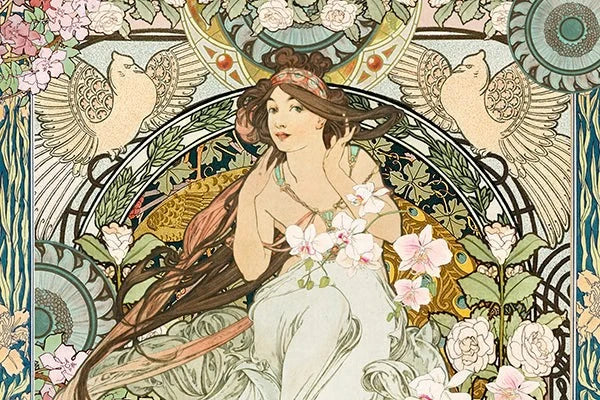
Emerging in the late 19th century and flourishing from roughly 1890 to 1910, Art Nouveau arrived as a rejection of rigidity. Built on fluidity, ornament, and natural form, the movement looked to flowers, vines, water, and the curve of the body as its foundation. At a time when industrialization was reshaping the world, Art Nouveau returned to nature, creating a visual language that felt organic, decorative, and alive.
Unlike Art Deco, which would later define glamour through sharp geometry, symmetry, metallic finishes, and the polished energy of the 1920s and 1930s, Art Nouveau moved differently. It curved instead of cut. It bloomed instead of glittered. Its beauty came through craftsmanship, botanical detail, and ornamentation that felt intimate rather than architectural.

This is precisely why Art Nouveau became the dress code for The Walking Body.
With a show centered on the body’s lived history communicated through posture, pace, balance and breath, Art Nouveau gives that concept a visual language. Its curved lines, botanical details, and natural forms reflect the way the body moves, holds tension, and eventually releases it.

What to wear
Flowing silhouettes
Choose pieces that move with the body rather than hold it in a stiff shape.
Examples: draped dresses, bias-cut gowns, long skirts, wide-leg trousers, soft blouses, relaxed tailoring.
Natural and botanical details
Art Nouveau often referenced flowers, vines, leaves, insects, water, and the female form.
Examples: floral embroidery, vine-like patterns, lace with organic motifs, leaf-shaped jewelry, soft botanical prints.
Curved lines
The movement is known for its curved, whiplash-style lines rather than sharp angles.
Examples: curved necklines, scalloped edges, draped sleeves, rounded jewelry, asymmetrical lines that feel soft instead of harsh.
Soft tailoring
Choose tailoring that feels refined but not stiff or overly corporate.
Examples: velvet blazers, relaxed suits, long coats, tailored vests, pleated trousers, softly structured jackets.
Ornament and craftsmanship
Art Nouveau valued detail, but not in a loud or overly flashy way.
Examples: beading, embroidery, lacework, brooches, pearls, filigree jewelry, delicate embellishment.
Soft, rich fabrics
The dress code should feel tactile and elevated.
Examples: silk, velvet, lace, chiffon, satin, organza, sheer layers, embroidered fabrics.
Jewelry with organic shapes
Jewelry should feel curved, natural, or hand-crafted rather than geometric.
Examples: pearls, cameos, curved gold earrings, floral brooches, vine-like necklaces, shell or leaf-inspired pieces.

Historical References
Alphonse Mucha posters
Mucha’s work is one of the clearest Art Nouveau references. His women were often shown with flowing hair, curved lines, floral halos, soft drapery, and ornamental framing. For the dress code, this translates into movement, softness, and detail.
René Lalique jewelry
Lalique’s jewelry often used natural forms such as insects, flowers, wings, and curved lines. This is a strong reference for accessories: delicate, organic, and sculptural.
Liberty fabrics and decorative arts
Liberty became closely associated with Art Nouveau through floral textiles and decorative patterns. This supports the use of botanical prints, soft fabrics, and detailed pattern work.
Late 1890s to early 1910s eveningwear
The period favored elongated lines, high necklines, lace, embroidery, soft layering, and delicate ornament. Guests do not need to dress historically, but these references can guide the mood.
Let this guide inform the final look through texture, movement, detail, and restraint. The interpretation can be subtle or more direct, as long as it feels considered, elevated, and appropriate for the evening. We’ll see you at The Walking Body.
May 22
7:00 PM - 9:00 PM
Located at The International Museum of Surgical Science, 1524 N Lake Shore Dr, Chicago, IL 60610
Event tickets


Leave a comment
This site is protected by hCaptcha and the hCaptcha Privacy Policy and Terms of Service apply.