
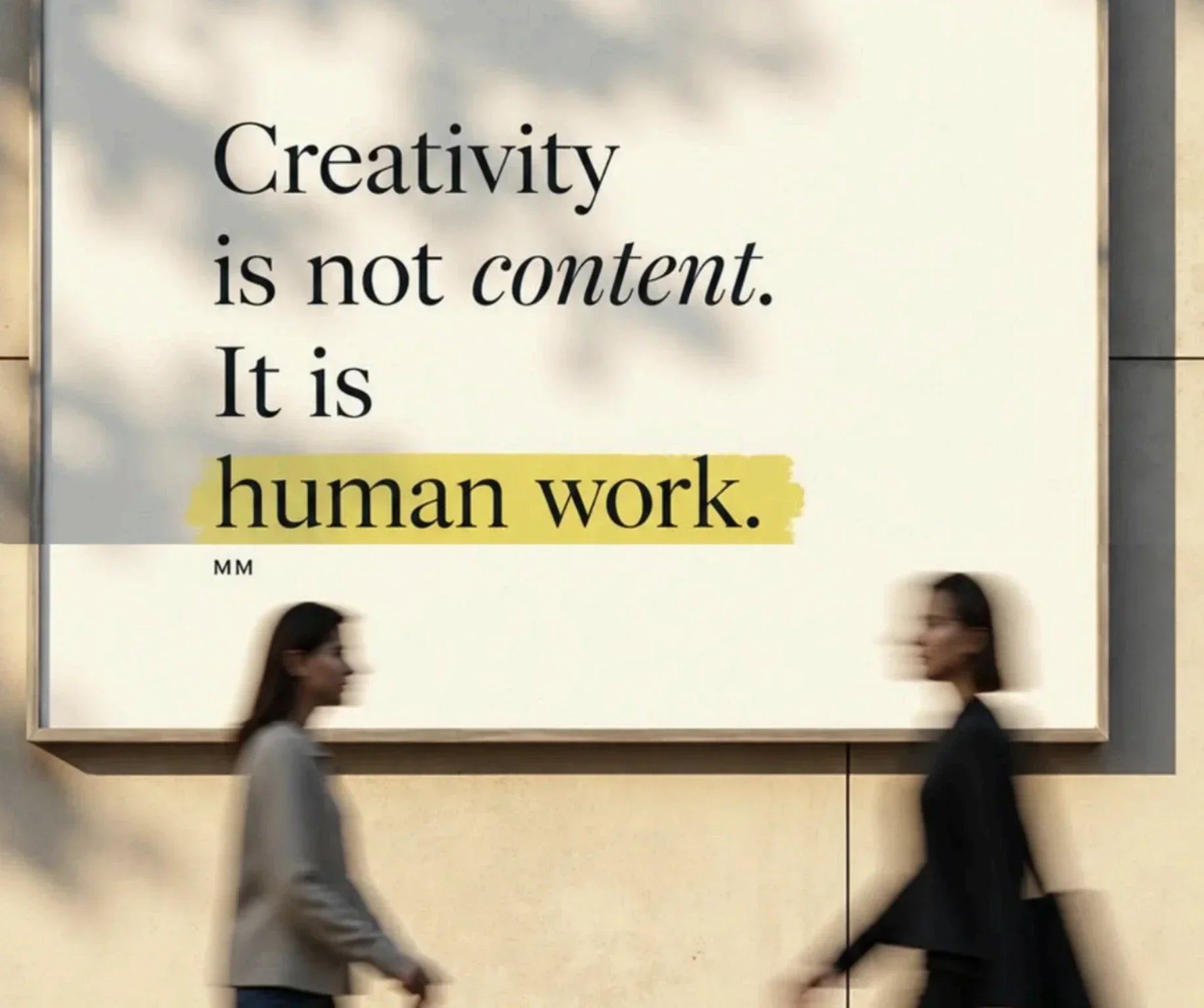
The Creative Economy Has a Value Problem
The Edit — MM Productions
The Creative Economy Has a Value Problem
For decades, a creative design career carried a certain promise.
If you were talented enough, worked hard enough, and built the right connections, you could carve out a career doing what you loved. Whether it was fashion, photography, design, writing, filmmaking, or art, creativity was viewed as both a profession and a contribution to culture.

Today, that promise feels increasingly fragile.
We often hear that we are living in the creator economy, a time when technology has democratized access to creative careers. Anyone can start a brand, launch a newsletter, build an audience, or showcase their work online. The barriers to entry have never been lower.
Yet for many creatives, making a sustainable living has never felt more difficult.
As someone who has worked across fashion, design, and technology, I've watched the definition of creative work shift dramatically over the last decade. The opportunities have expanded, but so have the expectations. Creatives are no longer just expected to create. They are expected to market themselves, build personal brands, manage content calendars, understand analytics, master new software, navigate algorithms, and continuously produce work at a pace that was unimaginable just a few years ago.
The central paradox
The result is a paradox.
There is more creative content being produced than ever before, yet creative labor itself often feels less valued.
Part of this stems from technology. Digital platforms have made creative work more accessible, but they have also contributed to the perception that creative work should be faster, cheaper, and constantly available. Consumers have become accustomed to endless streams of content. Businesses have become accustomed to quick turnarounds. The amount of effort required to produce meaningful creative work remains the same, but the perceived value of that work has shifted.
There is more creative content being produced than ever before, yet creative labor itself often feels less valued.
The creative economy
AI and the culture of output
As we all know, AI, Artificial intelligence, has added another layer to this conversation.
AI tools like Firefly, DALL-E, and Midjourney can now generate images, videos, copy, and concepts in just seconds. For some, this represents an exciting new era of productivity. For others, it raises concerns about authorship, originality, and the future of creative professions.
The challenge is not simply that AI can create content.
The challenge is that it reinforces a mindset that prioritizes output over process.
The value exists in the thinking behind the work.
Creative work has never been valuable solely because of the final deliverable. Its value comes from research, observation, experimentation, storytelling, and lived experience. A logo is not valuable because it exists. It is valuable because of the thinking behind it. A garment is not meaningful because of the fabric alone. It becomes meaningful because of the ideas, culture, and craftsmanship embedded within it.
When creative work is viewed only through the lens of efficiency, those invisible contributions become easy to overlook.
Creativity in an uncertain economy
The pressure facing creatives today extends beyond technology. Economic uncertainty, rising living costs, shrinking arts funding, and increased competition have made creative careers more precarious. Many talented artists, designers, writers, and makers are finding themselves juggling multiple jobs simply to continue pursuing the work they care about.
At the same time, businesses continue to rely on creativity more than ever.
Brands compete through storytelling. Products compete through experience. Organizations compete through innovation. Creativity is often described as one of the most valuable skills for the future workforce, yet many creative professionals struggle to receive compensation that reflects that value.
This contradiction reveals a larger issue.
We celebrate creativity in theory while undervaluing the people who produce it.
The value problem
Building a sustainable future
Moving forward, the conversation should not be about protecting creativity from technology. Technology will continue to evolve, and creative industries will continue to adapt. They always have.
Instead, we should be asking how we create sustainable futures for creative professionals.
How do we compensate creative labor fairly?
How do we create pathways into creative industries that are not limited by privilege, geography, or financial resources?
How do we ensure that innovation enhances human creativity rather than replacing the people behind it?



Leave a comment
This site is protected by hCaptcha and the hCaptcha Privacy Policy and Terms of Service apply.