
Chicago’s Fashion Engine
How the Incubator Rose, Worked, And Fell Apart
From a distance, twenty years of Chicago fashion paint a clear picture: starting with a spectacle down the side of a department store, resulting in a city-backed fashion week with a mayor’s council, and a working incubator embedded inside Macy’s. So the question is, how did a once thriving creative destination pivot into a lecture series on a college campus. From MM Productions’ vantage point, this is not just a history lesson. It is the blueprint for the gap we are now stepping into.
The Origin Myth: An Upside Down Start
To understand Chicago’s modern fashion story, you have to start by looking up.
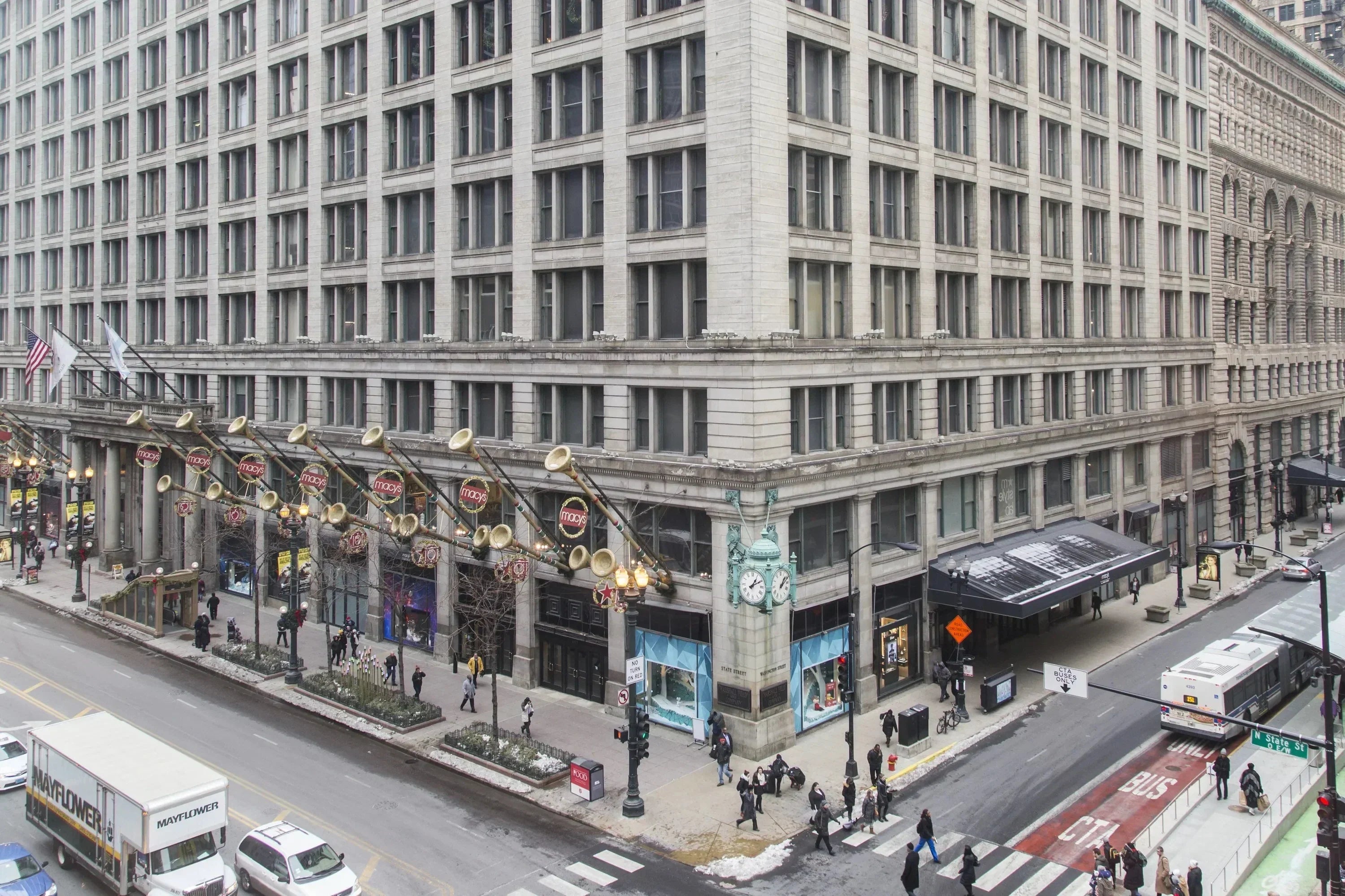
It is September 2003, and Marshall Field’s has turned its State Street flagship building into a vertical runway. Models and acrobats are rigged from the roof, suspended against the limestone, gliding down the side of the building while thousands of people pack the street below. Inside, the store is celebrating a renovation and an expanded roster of designer labels. Outside, Chicago is quietly writing its own legend.
The stunt did exactly what it was engineered to do. It filled State Street with spectators, landing national coverage, including a Good Morning America segment where Diane Sawyer was quoted saying that Chicago had outdone New York Fashion Week. But most importantly, it caught the eye of Mayor Richard M. Daley.
In retrospect, that single show functions as Chicago’s fashion origin myth of the 2000s. At the time, Chicago already had scale: more than 250 designers, four fashion design programs, a serious retail spine, and an ecosystem of stylists, PRs, and production crews. What the city lacked was a cohesive narrative. The vertical show supplied the proof that a bold, site-specific fashion spectacle could put Chicago on the global map.
From MM’s perspective, this is the first lesson. A city takes fashion seriously when it is willing to invest in artistic expression.
Building a System: Block 37, Fashion Focus, And The Mayor’s Fashion Council
What began as a stunt evolved into a framework.
In 2004, Marshall Field’s and the City of Chicago kept pushing, turning the long-empty Block 37, across from the State Street store, into a makeshift stage. Designers like Michael Kors, St. John’s Marie and Kelly Gray flew in for public events that recast Chicago as a fashion destination rather than a place you simply pass through.
By 2005, that energy coalesced into Fashion Focus Chicago, a city-backed fashion week, created to showcase local designers while marketing the city to the world. The programming had the kind of civic gloss that feels almost surreal now: mayoral breakfasts and press conferences, celebrity appearances from Jennifer Lopez and Sarah Jessica Parker, styling seminars, competitions, and a dedicated Chicago Designer pop-up inside Marshall Field’s.
At the same time, the Chicagoland Entrepreneurial Center was clocking a different reality. Working closely with the surge of local fashion entrepreneurs, they saw that designers had the same core challenges as any founder: capital, operations, supply chain, sales. What they were missing was a fashion-specific support system. There was no shared studio, no one to walk them through pattern and production, and no clear path to the buying floor.
On a 2005 business trip to Toronto, Mayor Daley and First Lady Maggie Daley toured the Toronto Fashion Incubator and saw an answer: a city-supported workspace where designers operated like real companies inside a tailored infrastructure. Daley returned convinced that Chicago needed its own version.
In June 2006, he appointed Melissa Gamble as the city’s first Director of Fashion Arts and Events. One of her first moves was to establish the Mayor’s Fashion Council, a volunteer advisory body of designers, retailers, educators, and industry professionals. Their mandate was practical: support emerging and established designers and help fashion students cross the bridge from school into careers.
Behind the Fashion Focus tents, the City, the CEC, Marshall Field’s and a small circle of partners were working on something more durable. The result would come to be the Chicago Fashion Incubator.
From MM’s analysis, this was a rare moment of civic clarity. City Hall, the department stores, and the startup ecosystem briefly agreed on one thing: designers are founders, and they deserve the same level of support.
The Incubator On 11: Designers As Founders Inside Macy’s
The incubator was designed in a classroom before it ever existed in a building. In 2007, Columbia College Chicago fashion professors Dianne Erpenbach and Dana Connell turned their senior capstone into a live planning lab. Students were asked to define what an incubator would actually require: square footage, machines, curriculum, staffing, funding. Their work became the model for what eventually opened on State Street.
Macy’s, by then the owner of Marshall Field’s, committed real estate: 2,375 square feet on the 11th floor of its State Street flagship. Inside that carved-out space were three shared offices for Designers-in-Residence, a manufacturing workroom, a flexible conference-and-showroom area, long cutting tables, 17 sewing machines, and a row of Apple computers.
In August 2008, the Chicago Fashion Incubator at Macy’s on State Street officially launched as a 501(c)(3) nonprofit. Its mission was clear: provide Chicago-based designers with the resources, business acumen, and mentoring needed to launch and scale their labels.
These changes established a functional working studio, not a concept. Designers drafted, cut, and met with buyers, while using the same space as office, showroom, and lab. From there, collections moved onto runways at Fashion Focus, StyleMax, into Macy’s trunk shows, and on pop-ups across the city. Supported by a “Master Designer” program that brought in names like Tommy Hilfiger for mentorship and visibility. Hearing this now, all happening in Chicago sounds like a dream.
But simultaneously, the macro picture was shifting. After Chicago’s failed 2016 Olympic bid in October 2009, the State of Illinois pulled the civic funding that had been propping up Fashion Focus. The event’s budget dropped from roughly $400,000 to about $70,000. Private partners, including StyleChicago, were asked to carry a greater share of the costs. The runway tents still went up, but the scaffolding around them had begun to creak.
Even as public investment thinned, the incubator itself kept gaining structure. In 2011, the Driehaus Entrepreneurial Center was added, funded by the Driehaus Design Initiative. It supplied research tools, business education, and programming for both current and alumni designers. That same year, Fashion Focus opened with a tented runway in Millennium Park featuring fifteen incubator designers as the headline. The incubator had become the narrative heart of the city’s fashion week.
For MM, this period is crucial. It proves that when designers are given the tools they need to thrive, they begin to operate as founders and are positioned for sustainable careers.
Slow Unraveling: When The Tent Came Down
By 2012, the cracks were starting to show.
Time Out Chicago reported that the Fashion Focus budget had been slashed, and the Daley-era emotional investment in fashion did not carry over in the same way under Mayor Rahm Emanuel, even as his own household quietly wore and supported local designers. Within the industry, a key question surfaced: was Fashion Focus a serious engine for brand growth, or simply an entertaining civic gesture?
The Mayor’s Fashion Council drifted to the margins of planning. Designers began to ask whether runway visibility was translating into sales, production capacity, or any real national profile.
Meanwhile, inside Macy’s, the incubator kept working. Cohorts cycled in and out, the alumni base grew, and the program became one of the few fashion incubators in the United States to run that consistently.
Over time, that quiet strain turned into a break. In 2015, after a decade, the City of Chicago ended Fashion Focus. Around the same time, Macy’s shut down Glamorama, its high-production charity fashion show that had, for years, been an anchor spectacle in multiple cities. In retrospect, coverage from StyleChicago and others makes one thing clear: in those later years, the most visible parts of “Chicago fashion week” were being held up largely by private sponsorship and goodwill.
Despite the challenges, the incubator outlasted the end of Fashion Focus, cycling through directors including Kim Prodan, Lara Miller, and Tonya Gross. It continued to operate as a nonprofit home for designer-led small businesses anchored in the old Marshall Field’s building.
As we see it, this marks the shift from the fashion-week era to an infrastructure built around studios, equipment, and education. The public stage shrank, but the working floor remained.
A Strong Node In A Thinning Network
The years after Fashion Focus ended, roughly 2016 to 2019, were quieter but no less significant. With no city-produced Fashion Focus and no Glamorama, Chicago no longer had a single civic fashion tentpole. Smaller, independent shows and markets quietly filled the gap.
Despite these challenges, the Chicago Fashion Incubator kept going. Over fifteen years, it supported 65 designers through its Designer-in-Residence program. Alumni went on to win awards, including Fashion Group International Rising Star honors, and even appeared on platforms like Project Runway.
In 2019, the incubator made a physical bet on its own future. Moving from Macy’s 11th floor into a larger, roughly 4,600-square-foot space in the Chicago Pedway. Still within the historic building but with more room for events, education, and community programming. The layout mirrored the original workroom with cutting tables, sewing machines, offices, and showrooms, but bigger.
On paper, the move read as optimism. Even as the visible, city-backed fashion apparatus disappeared, the working engine of the incubator continued to scale up.
Pandemic Pressure And A Quiet Rethink
Then came COVID-19.
In 2020, the idea of a shared studio in a downtown building collided with public health reality. The incubator had no choice but to pivot, moving to Zoom-based mentoring, virtual trunk shows, and online workshops. New cohorts still came in, and the total number of supported designers rose to 65. The work continued, but the value of physical space had to be reconsidered.
Throughout this period, Columbia College Chicago’s relationship with the incubator deepened. The school had been present since the original 2007 capstone, and by the early 2020s, Columbia’s fashion faculty and students were woven into the incubator’s events and mentorship. Melissa Gamble, once the city’s Director of Fashion Arts and Events, was now a professor in Columbia’s Fashion Studies program, serving as a living bridge between the incubator’s civic origins and its now academic future.
By late 2023, a hard, pragmatic question surfaced: could a relatively small nonprofit sustain a studio-based incubator in downtown Chicago without the structural support it had in the mid-2000s? The unfortunate answer was ultimately no.
In December 2023, the Chicago Fashion Incubator announced that it would end its physical Designer-in-Residence program and “re-envision” its mission. The decision did three things:
Wound down the residency program at the end of 2023.
Gifted an endowment to Columbia College Chicago.
Established the Chicago Fashion Incubator Speaker Series at Columbia and directed their support toward the school’s Fashion Study Collection.
Beginning in 2024, the mission to strengthen the fashion community would live on in lectures, workshops, and archival work operated by Columbia’s Fashion Department.
The incubator refused to simply disappear. It allowed the machinery of residency and workrooms to sunset, but it embedded its ethos into an institution built for longevity.
Looking back at it now this was a graceful yet bittersweet, pivot. The knowledge survives but the physical infrastructure does not.
Why It Came Apart
Looked at as a trajectory instead of a drama, the reasons the system thinned out are structural rather than personal.
Funding fragility
Fashion Focus and its surrounding programming were always funded by a mix of city money, state grants, and corporate sponsorship. When Illinois pulled fashion funding after the failed Olympic bid, the budget drop forced private partners to cover the cost gap for years, but there is a limit to how long a “city fashion week” can run on sponsorship and goodwill alone.
Shifting political attention
Under Daley, fashion held an emotional and symbolic place in the city’s story. It was part of how Chicago saw itself on the global stage. Later administrations had different priorities. Fashion did not vanish, but it was no longer treated as a civic instrument in the same way.
A blurred mission at the public-facing level
Fashion Focus always sat between two purposes: city branding and designer support. As journalists reported at the time, many designers were never fully convinced the event was designed for their commercial success. Without a clear mandate, it became difficult to defend the budget when pressure mounted elsewhere.
An incubator that worked inside an ecosystem that thinned
The Chicago Fashion Incubator did what it promised to do. It treated designers as founders, gave them focused support, and helped real businesses grow. What faded was everything around it: the big runway shows, the department store spectacles, and the sense that fashion was a shared civic project.
institutional gravity
In the end, the only way to protect the incubator’s mission was to let it be absorbed by a college. The move to Columbia gave the work a stable institutional home, but it also meant relinquishing the studio floor the program had been built on.
As we see it, the incubator did not “fail” as an idea. It proved that designers are serious economic actors, and with the right support can create a career for themselves. The collapse happened in the funding, the politics, and the loss of the public spectacle around it.
What’s Left, and Where MM Steps In
Today, what remains of that twenty-year arc looks like this:
A generation of designers who passed through a rigorous incubator, many of whom are still working and building.
An endowment-backed speaker series and fashion collection at Columbia, carrying the intellectual and educational side of the mission forward.
A city still rich in production talent, venues, and audiences, but with no central, physical incubator and no city-run fashion week to pull that talent into a shared story anymore.
What is missing is a real base: a place where designers can treat the city as a working studio, not an occasional backdrop. A shared space with tools and production support. Runway moments with real stories behind them, built for sales and growth as much as glamour. A scene that can hold both the needs of founders and the needs of local fashion development.
That absence is the space MM Productions occupies.
When we study Chicago’s fashion engine, from the models rappelling down a department store wall to the last Designer-in-Residence packing up her studio in the Pedway, we are not looking back with nostalgia. We are taking inventory. We see how powerful it was when fashion policy, retail, production, and education briefly moved in sync. We also see how vulnerable that system was.
Our work is shaped by that history. We approach designers as founders, build shows as working platforms as much as experiences, and treat the city itself as a network of stages for what comes next in fashion.
The incubator rose. It worked. The architecture around it fell apart. What comes next in Chicago will be defined by who is willing to rebuild the scaffolding and keep it standing. MM intends to build it.
Sources
Chicago Fashion Incubator, “The History of the Chicago Fashion Incubator”
(CFI origin, Marshall Field’s vertical fashion show, board formation, Columbia capstone course, launch at Macy’s, Driehaus Entrepreneurial Center, 2019 Pedway move, total designers, mentors, alumni outcomes).
Chicago Fashion Incubator, “About Us” and “Mission / Speaker Series”
(Nonprofit status, space specifications, DEC details, Pedway relocation, 2023 transition to Columbia College Chicago, Speaker Series structure and focus).
Time Out Chicago, “The Future of Fashion Focus”
(Fashion Focus budget drop from approximately $400,000 to $70,000, loss of state funding after the failed Olympic bid, shifting political priorities under Mayors Daley and Emanuel, evolving role of the Mayor’s Fashion Council, questions around Fashion Focus’s impact).
Chicago Sun-Times, “Opening night of Fashion Focus Chicago spotlights CFI designers”
(2011 Millennium Park opening-night runway featuring 15 Chicago Fashion Incubator designers, CFI’s integration into Fashion Focus).
StyleChicago recaps and related coverage cited in Time Out Chicago
(End of Fashion Focus after 2015, private funding of finale runway shows and FashionChicago pop-ups, context for the final years of Chicago’s city-backed fashion week).
Wikipedia, “Glamorama (Macy’s)”
(History and conclusion of Glamorama in 2015, framing Macy’s high-production fashion spectacle era).
Chicago Fashion Incubator main site
(Confirmation of date ranges, program structure, partnership with Columbia College Chicago, and program evolution).

Leave a comment
This site is protected by hCaptcha and the hCaptcha Privacy Policy and Terms of Service apply.