
The Archive Act: Vintage Frills at Venetian Veil
How a Logan Square vintage shop holds the centre of MM’s most environmental show to date
A middle act built from pre-loved clothes
The girl in the tuxedo jacket does not walk like she is wearing a relic. She moves as if the look was built for tonight, not borrowed from another decade; the clean black lines and white piping sit with the ease of something made for this season.

Model wearing: https://www.mm-productions.io
Around her, Venetian Veil is already in motion. The first act has set its story; the finale waits in the dark. In the middle sits something quieter, more pointed. Every look that follows is built from pieces with previous lives, but on the runway they read as present-tense clothes, the kind you could walk out in tonight.
This is the Vintage Frills act, the archive chapter. MM puts an all pre-loved lineup at the centre of the show and expects it to hold a luxury standard.
A Logan Square archive with a runway eye
Vintage Frills itself is a study in reuse. Founded by Jennifer Kelly, the Logan Square shop is organised by colour and mood, its rails lined with clothing and accessories pulled from past decades and edited down until only the strongest pieces remain. Nothing here is new, but everything is chosen to go back into circulation. Day to day, that work happens quietly, one garment at a time. In Venetian Veil, the same archive is scaled up and asked to carry an entire collection.
For Venetian Veil, MM lifts that archive off the shop floor and puts it at the centre of the runway. Vintage Frills appears as the full second collection, styled by Yue Designs under one rule: every garment is pre-loved. The segment sits in the middle of the show with the same weight as any other collection, treated as the brief, not the exception.

The line between archive and costume
The risk is obvious. Vintage on a themed runway can easily tip into pastiche. One detail too literal, one gown too period, and the mood slips from cinema into dress-up. Venetian Veil avoids that through a precise division of labour: Vintage Frills curates garments whose cut, fabric and proportion still hold; Yue takes those pieces and styles them to read as now.
How Jennifer Kelly learned to see
To understand why the experiment works, we have to go back to Jennifer Kelly.
Her story starts in resale, with days spent around secondhand racks, a teenage shift behind the counter in a neighbourhood thrift store, then a long run through retail. Fast-fashion chains paid the rent while luxury houses sharpened her eye. Years on shop floors and in stockrooms taught her how a seam should sit, how a jacket should balance on the body, and how a bag should feel in the hand before any branding enters the frame.
Vintage Frills is that training redirected. Instead of taking the traditional, easier retail path, she applies a luxury standard to what already exists. Everything is pre-loved; her work is in judging pieces on cut, fabric, longevity, trend and heritage. Colour and mood organise the space, but the hidden logic is in what makes it onto the rail and what does not. Prices are set so a student can buy one great piece and a stylist can build a full story without blowing a budget.
That discipline is what makes the Venetian Veil segment possible. Vintage Frills does not function like costume hire; it operates as a working archive, kept tight enough that an entire runway act can be drawn from a single, well-edited set of clothes.
On the night: the Vintage Frills procession
On the night, the Vintage Frills act arrives like a grounded exhale between two fantasies. Where the opening chapter speaks in overt narrative, the middle segment speaks in wardrobe. Yue Designs draws a clear line through the archive, translating Jennifer’s colour-blocked world into a masked procession that feels plausible, as if the best-dressed guests have wandered onto the stage.

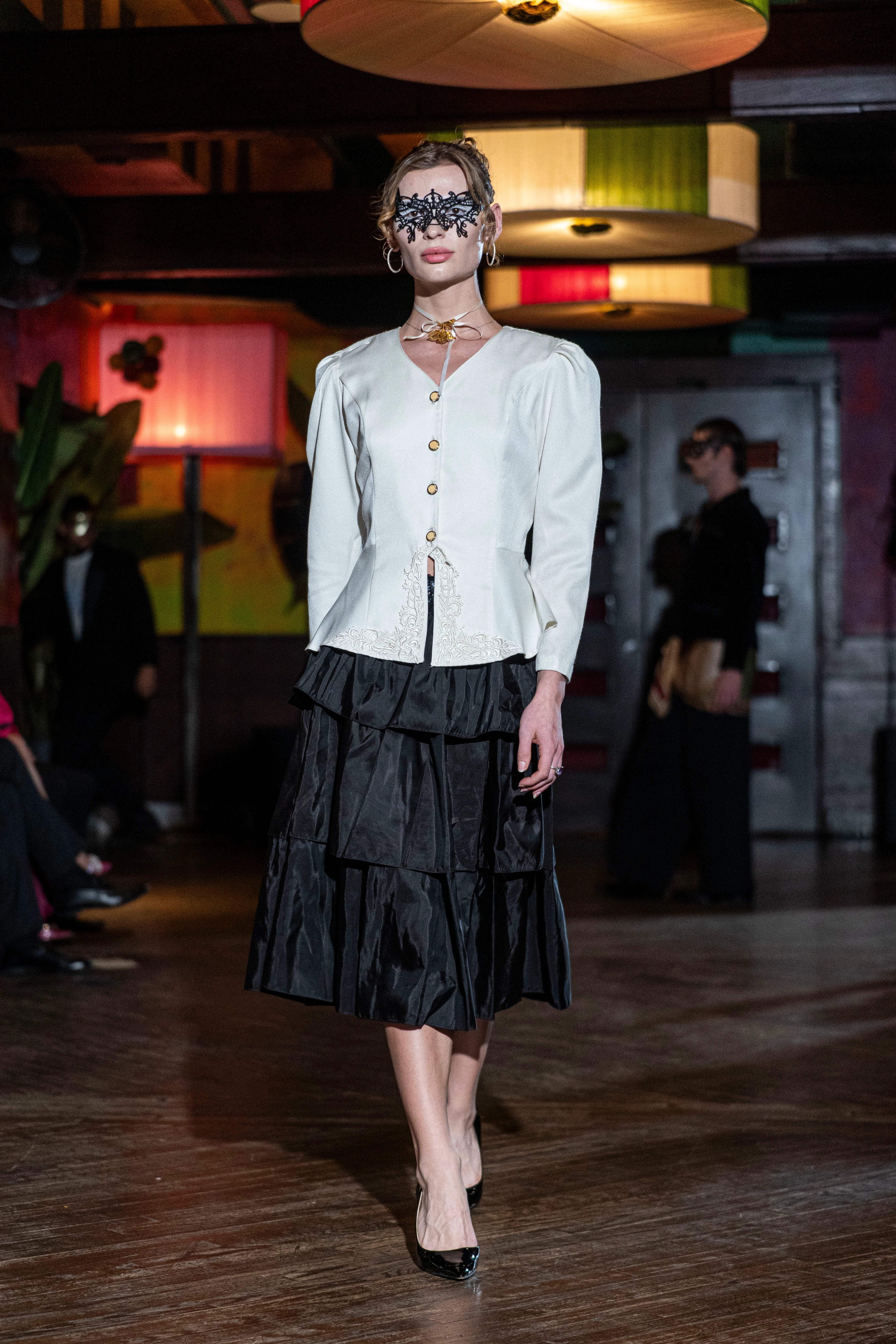
One look in particular catches the logic. A double-breasted blazer in soft mahogany wool is left slightly open over a lace camisole that could easily have belonged to someone’s grandmother. On paper, the combination might tilt into costume; under Venetian Veil’s lights, it lands as a girl leaving a party too late, mask still in place, shoulders squared against the cold. You see the grain of the past in the textile, but the silhouette is firmly present.
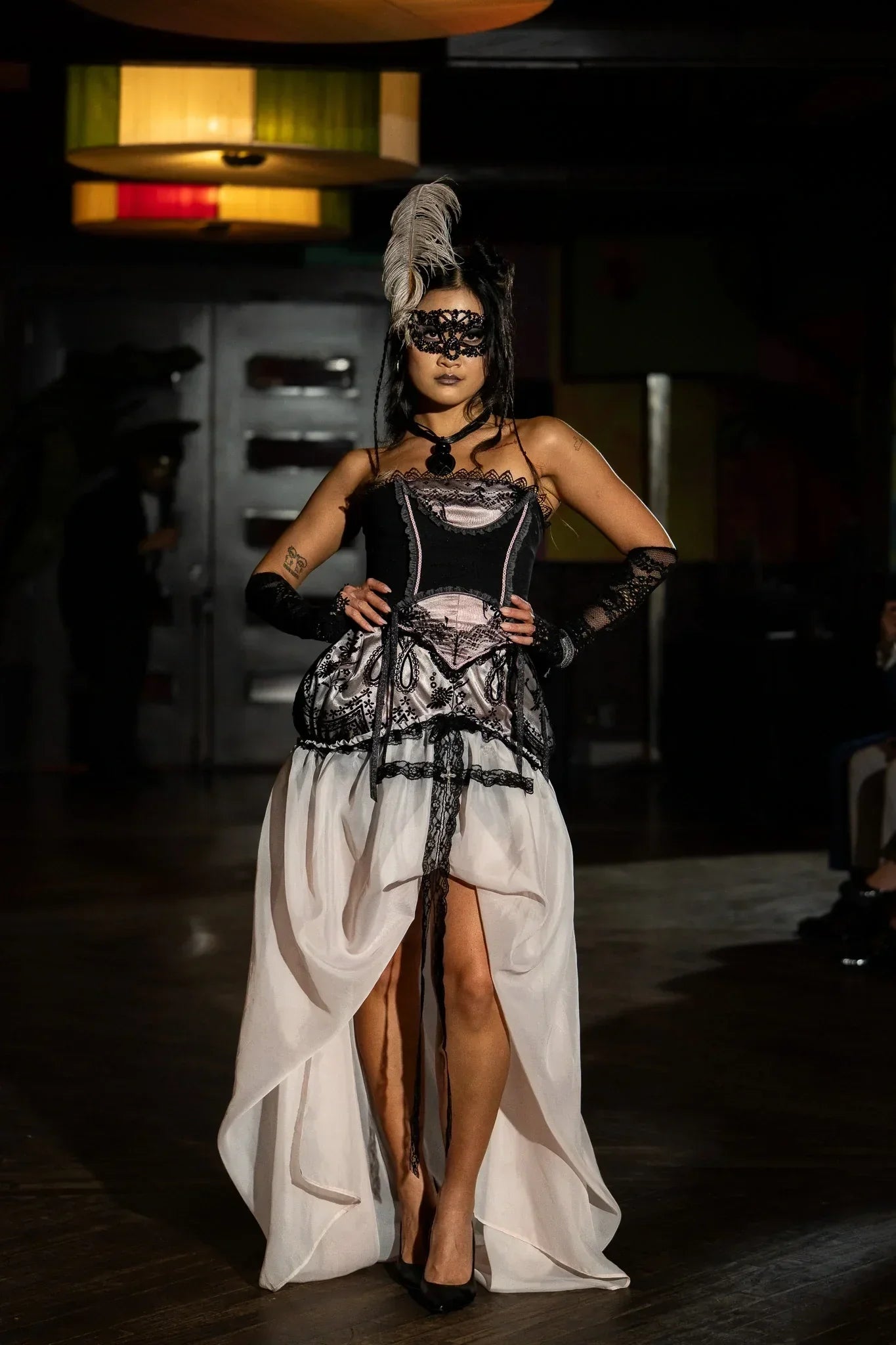
Elsewhere, jackets sit correctly on the shoulder, trousers skim the floor, slips move cleanly under the lights. Nothing leans on its age for effect. These are clothes that could walk straight off the runway and back into a life, which is why the segment never reads as a thrift experiment.
What holds the act together is restraint. Yue resists the easy trick of playing up “vintage-ness”. There is no ironic piling of decades, no winking retro pastiche. Masks stay within a narrow visual vocabulary. Colours anchor to Venetian Veil’s palette, with the occasional print treated as an accent rather than a theme. Hair and makeup stay in conversation with the other acts, so that when a Vintage Frills look appears, it feels like a continuation of the narrative rather than a guest performance.
The result is that you stop thinking about the clothes as secondhand. You start thinking about who these characters are.
Backstage: the work behind the romance
Backstage, the romance is entirely practical. An all-pre-loved act demands meticulous pre-production. Pull days at Vintage Frills involve rails of potential: tuxedos, slips, jackets, suits, small oddities that might become the hinge of a look. Pieces are checked for construction, cleaned, repaired where they need it, steamed into readiness. The runway rack is then organised like a story. Each look has its own cluster of tags, every garment numbered, logged, then packed to travel.
On the day of the show, the choreography between archive and team becomes part of the sustainability story. Dressers handle garments that already belong to an existing ecosystem. Stylists work within a finite set of options. Model cards are annotated not just with designer credits but with the name of a vintage house that will take these pieces back into rotation when the night is over.
MM has long spoken about environmental preservation and the responsibility to style pre-loved pieces with the same care as new collections. Here, that line is held. There is no safety net of last-minute brand shipments in virgin plastic. If a piece does not work, the solution has to come from within the archive. The constraint sharpens the choices.
Sustainability, in this context, is not a marketing note attached to a fibre or a token capsule. It is the decision to treat an existing archive as runway-worthy material and to invest time, styling intelligence and technical craft into garments that already exist instead of producing a fresh rack of “sustainable” things.
What the audience actually feels
The Vintage Frills act also shifts the audience in subtle ways. From a seat along the runway, you watch looks that feel realistically wearable. It is easy to imagine these silhouettes refracted into your own wardrobe: a blazer shrugged over a slip you already own, a prom dress shortened and worn with heavy boots, a sequinned top reined in with tailored trousers. The fantasy is specific enough to feel elevated, yet close enough to your body that it suggests a change in behaviour.
There is an undercurrent of quiet critique. Venetian Veil is lush, atmospheric, full of orchestration, but the centre of the show is built without new production. The middle act proves that luxury can come from how something is selected, styled and lit, not only from the moment it leaves a factory. It does not lecture. It simply makes the alternative look good.
For MM, this segment is not a gesture; it is a necessity. If the mission is to turn runway into a live storefront that reflects a more responsible fashion future, then a full pre-loved chapter, handled at the same standard as any designer act, is non-negotiable. Vintage Frills gives that chapter specificity. It roots the theory of sustainability in a real Chicago shop, a real founder, a real set of garments that can be touched, tried on, lived in again.
Why the centre has to be pre-loved
What Venetian Veil shows, quietly, is that newness does not have to come from making more clothes. In the Vintage Frills act, it comes from selection and styling: how Jennifer Kelly curates the archive, and how Yue Designs asks those pieces to behave under a different brief. The looks on this runway have already done their time in other lives; the work now is to keep them moving, not to replace them.
The stakes behind that choice are blunt. Fashion is estimated to be responsible for roughly 4 to 8 percent of global greenhouse-gas emissions, more than all international flights and maritime shipping combined in some assessments. At the same time, over 100 billion new garments are produced every year, and around 92 million tonnes of textiles are discarded annually, much of it to landfill or incineration. Most of that impact happens before a piece is ever worn out. Research from WRAP’s Valuing Our Clothes project and subsequent analyses shows that extending the active life of clothing by just nine months can reduce its carbon, water and waste footprints by around 20 to 30 percent, and that doubling the lifespan of garments could cut fashion’s emissions dramatically.
An act like Vintage Frills takes those numbers out of reports and puts them under runway lights.
From the audience’s side, that reality sits just under the surface. The looks read as outfits that could fold back into a real wardrobe, not one-night costumes. The fact that the centre of the show is built without new production hums in the background; what lands first is that it looks desirable, and that it feels possible.
If Venetian Veil points to where MM is heading, the future of its runways will depend not only on what gets made next, but on which archives are invited to walk beside it. Vintage Frills has shown that its racks can carry that weight. The open question is how many other closets, shops and private collections will follow, and how ready audiences are to see “new” look like this.
Sources
WRAP, Valuing Our Clothes and related guidance on extending garment life and its impact on carbon, water and waste.
RGS / WRAP summary on clothing lifetimes and carbon savings from extending wear by 3–9 months.
WRAP- and WRAP-cited research on extending clothing life and its role as the “most significant opportunity” to cut fashion’s environmental impact.
Studies summarised by INTEXTER / UPC on re-use, including the 20–30% footprint reduction for nine months’ extra active use and the potential 44% emissions reduction if garment lifespans are doubled.
Global estimates of textile overproduction and waste, including 100+ billion garments produced annually and roughly 92 million tonnes of textile waste each year.
Shop the looks
Explore MM Collections inspired by Venetian Veil and Vintage Frills’ archive eye.

Leave a comment
This site is protected by hCaptcha and the hCaptcha Privacy Policy and Terms of Service apply.