

A salon built in one night
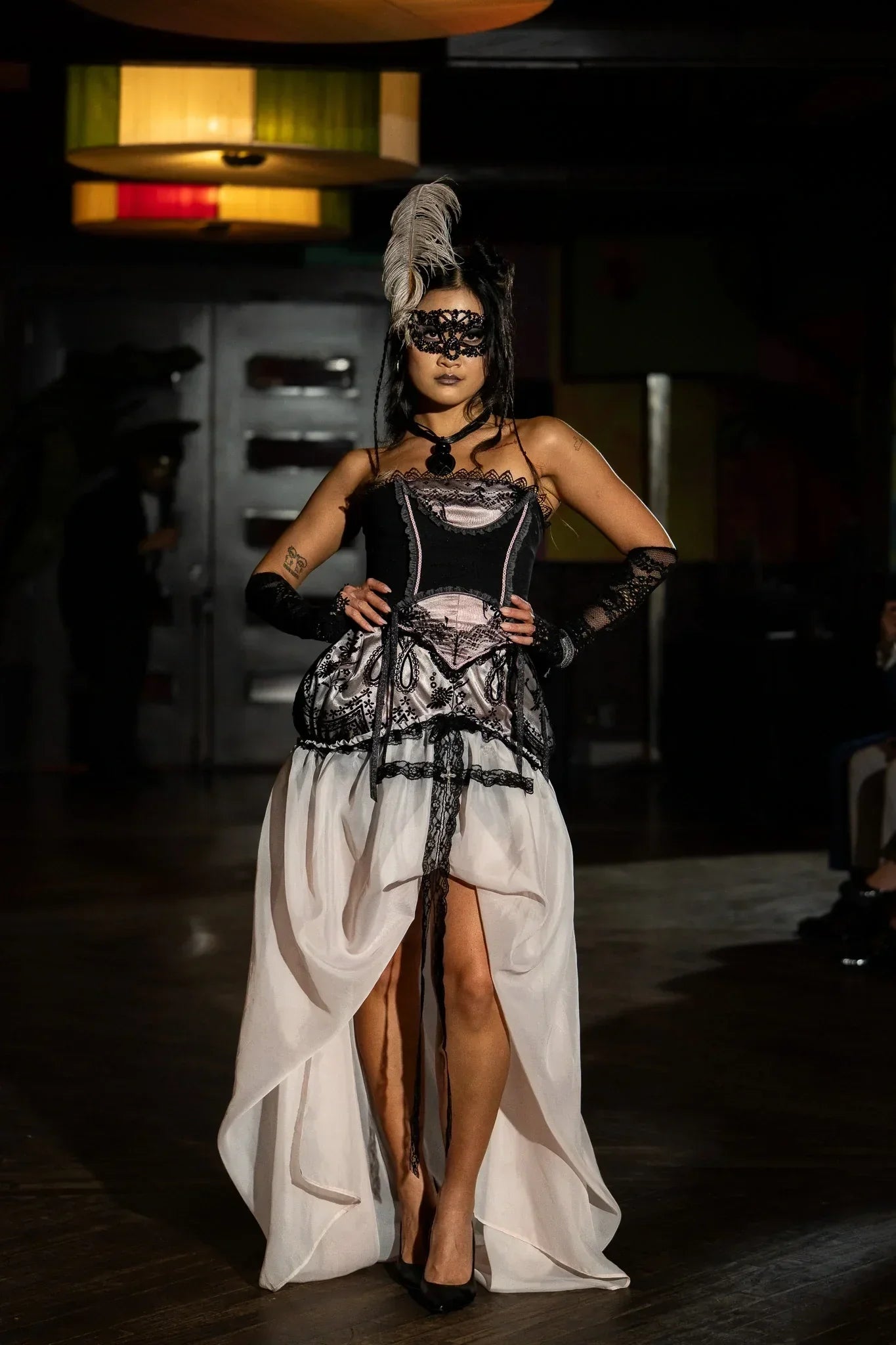
On a cold November night in the Fulton Market district, we welcomed guests into a room filled with masks, warm gold light and a low, steady pulse of bass. Located at Carnivale Chicago, Venetian Veil was our way of turning a fashion show into a live runway-to-retail system, with four acts, layered performances and a shoppable platform all working at once. Beneath the theatrics sat a simple question for us: what can a single night genuinely do for the creatives on our runway, and how far can we push that here in Chicago?
Inside Carnivale, we arranged the room like a salon. Lounge seating hugged the runway, bar-height tables filled the gaps, and lighting just low enough to soften the edges. A Victorian mood sat over classical strings while a deep bass line threaded through the space, DJed by Jason Hue.

Four acts, three clear voices
The first act made the strongest case for how this kind of night can work for a young designer. Olivia Bolanos, a local talent, opened with Shattered Fables, a collection built on the stories that shape childhood and the uncomfortable truths that arrive later. There was romance in the silhouettes, but the idea underneath was harder; separates and dresses often carried two moods at once. On a night that might easily have tipped into costume, Bolanos stayed close to pieces someone could live in.
Her collection also understood the mechanics of the room. The clothes read clearly at a distance and held together at arm’s length as models brushed past guests and tables. In a format that offers real-time shopping, that double readability matters. If the collection had simply slipped into ambience, it would have failed the designer. Instead, it showed how narrative and commerce can align: a tight edit, a clear point of view and a runway that behaves as a moving rack rather than a distant stage.
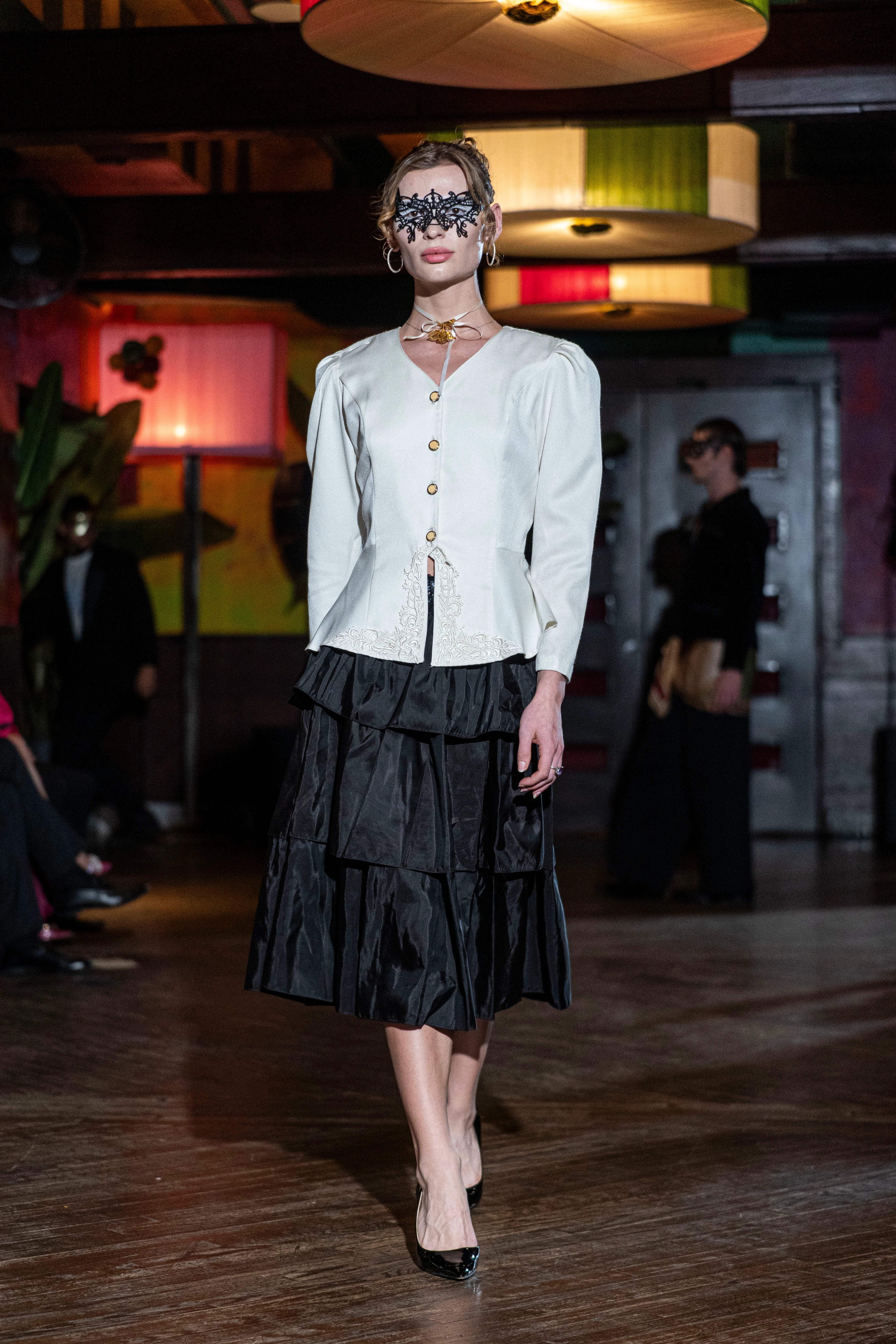
Vintage Frills, a curated vintage segment styled by Yue Designs, made a quieter but important argument for another kind of creative labour. Every piece was sourced, restored and prepared specifically for the show. The looks were not “new” in the usual sense, yet the work behind them was significant: hunting, repairing, styling and fitting. In an industry that tends to celebrate originality while quietly leaning on archive references, our decision to give curated vintage its own runway space read as a small adjustment to the usual narrative. It reminded the room that not all fashion work is sketch-to-sample; some of it is stewardship, an eye for what already exists and the belief that older garments deserve a second life on bodies rather than in storage.
There was a tension there, of course. Our model is built on instant purchase, and a vintage curator’s ideal outcome is not necessarily a mass sell-out through one platform, but a sustained reputation and the right buyers. Venetian Veil did not entirely resolve that contradiction, yet the segment landed strongly with our audience and translated into real demand. If we keep making space for non-traditional designers and collectors, “empowering creatives” can mean more than simply pushing sales.
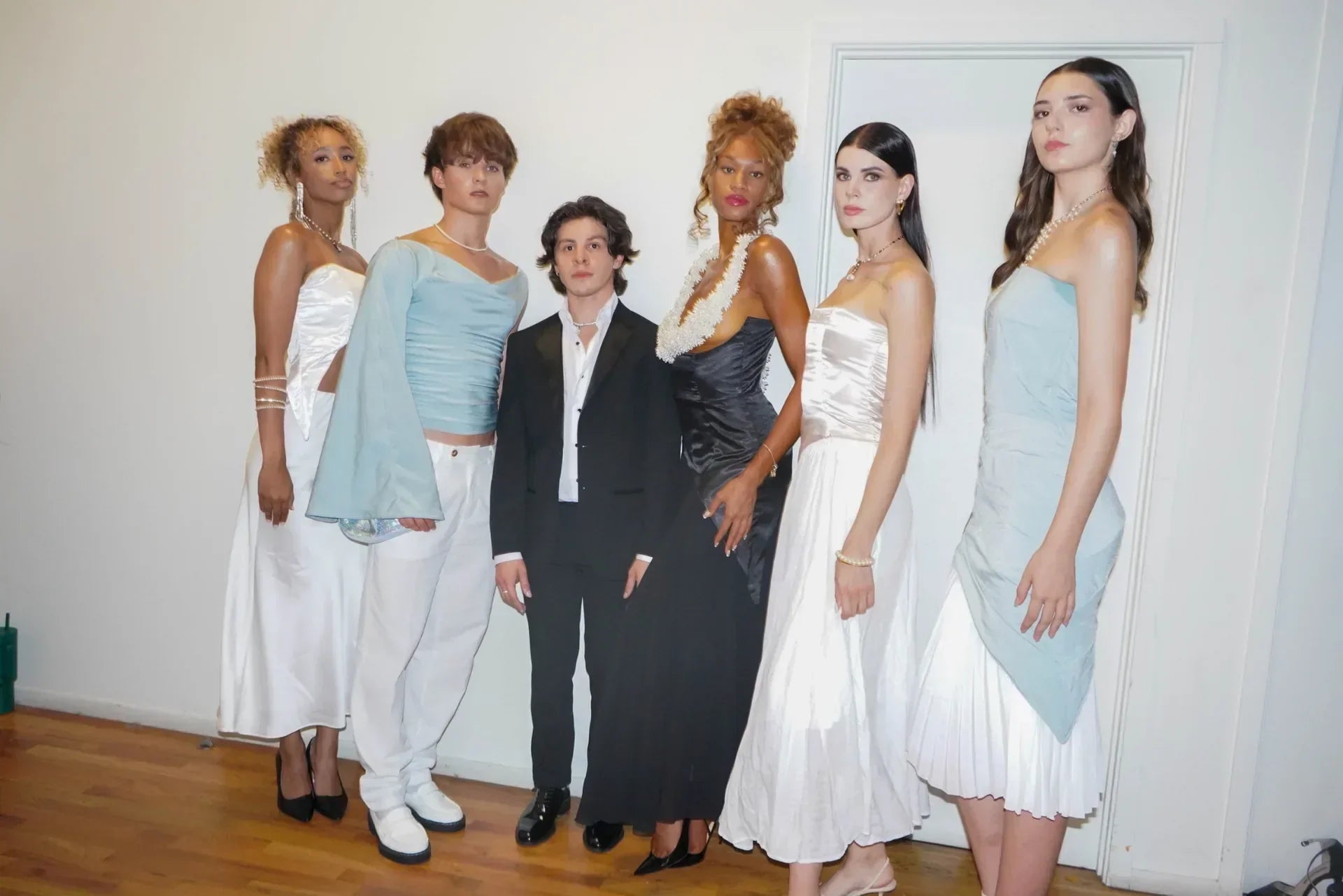
For the finale, our creative director, Luis Levonche, presented Perle Urbane, a study of how pearls form and are cultured, drawn in parallel to the human aging process. The concept begins in dark places, hardens through experience and emerges bright and strong. On the runway, that idea translated into clothes that sat between fragility and shell. Curve-tracing seams, controlled shine and disciplined volume set a clear standard for eveningwear. You could imagine a woman in these looks stepping off a carriage rather than stepping out of a limousine. As a closing statement, it reframed pearls as urban equipment rather than polite decoration, an elegant fit for a night in a city that has always favored steel over ornament.

Performance as a second skin
The performances at Venetian Veil did more than fill time.
Between segments, mentalist-pianist Sidney Friedman folded live, interactive card readings into his set, leaning into the night’s fixation on secrets and chance. Tarot reader Lillie moved through the crowd with one-on-one readings, adding a spiritual register to the room.
At times, the sheer layering of activations flirted with excess. In a few pockets of the night, the clothes risked becoming one more texture in a larger installation rather than the primary subject. It’s a delicate balance, particularly for emerging designers who benefit from moments of stillness as much as spectacle. That tension is something we know we’ll need to keep calibrating as this format evolves.

The invisible layer: tap to own
Underneath everything, an invisible system was doing quieter work. Every look on the runway was shoppable in real time through our platform. Using tap-to-shop technology, guests could move pieces directly from runway to cart and, in many cases, to purchase. This is where our idea of “empowerment” becomes very concrete: a structure in which a collection doesn’t disappear when the lights come up, but has a direct, working path from designer to wearer.
A community behind the masks
In the end, Venetian Veil felt less like a one-off concept and more like an early map of what a working fashion night in Chicago can be. It proved that atmosphere and commerce can sit in the same room, that local designers can remain at the center of that equation and that a show can generate both images and income for the people on its runway. The work now is to refine, not reinvent: to keep dialing in the conditions that let creativity, community and conversion support one another.
If a single masked night at Carnivale can do this much for our scene, what might be possible as we keep asking what a fashion show can do for its creatives?

Leave a comment
This site is protected by hCaptcha and the hCaptcha Privacy Policy and Terms of Service apply.